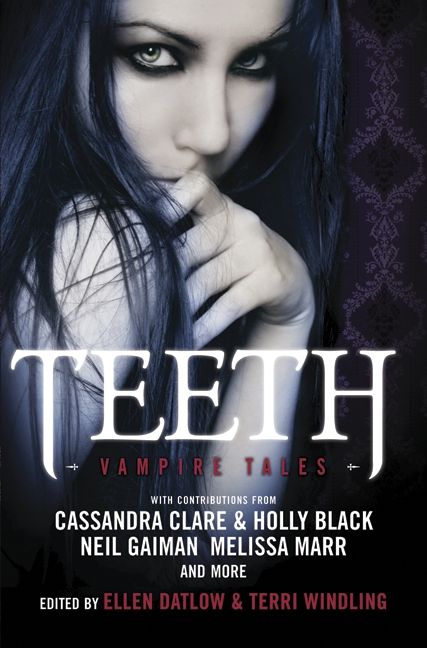
This is one of those collections that I’ve stopped and started multiple times. Because sometimes that’s what I do with a short story collection. And yet, I have enjoyed reading it almost every step of the way. There’s always something fun and interesting about a collection edited by Ellen Datlow.
Vampire stories are one of those things that I’m very much on the fence about. I mean, I often enjoy them. But because of the naughties, they became something that was slightly overdone. Probably one of the reasons this book came in and out of my shelves so much – I enjoyed it but didn’t want to overdo it either.
The stories in this run the gambit of vampire characterisation. Some are classical. Some are romantic. Some are just a little bit bizarre. But every story was fun and worth reading again.
Vampirism has become a daily occurrence – there are those in the high risk, those who just break the rules… but eventually a whole lot of people get turned. The future is showing us a whole new reality.
I liked the idea of this future world in which vampires are running free. And that they’re just kind of the next, logical evolutionary step to the pyramid. The fact that it’s also written all around the perspective of a teenager just works all that much better. After all, all of the stories at the moment surrounding vampires seem to be very young adultcentred.
One of the aspects I liked most about this story was the idea that those in the “high risk” category were considered different and amoral. It’s the same fear mongering that you see again and again throughout society. Which made me smile. A great reflection on society as we know it.
All in all, I really enjoyed this short story. It was a unique idea, but one that I felt kind of had merit. After all, there is definitely scientific support for the idea that we are all evolving into a new version of “humanity”, who’s to say it isn’t going to be as blood suckers?
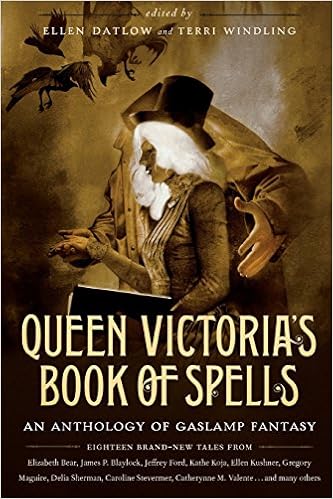
Gaslamp fantasy, or historical fantasy set in a magical version of the nineteenth century, has long been popular with readers and writers alike. Many wonderful novels, such as Stardust by Neil Gaiman, Jonathan Strange & Mr Norrell by Susanna Clarke, and The Prestige by Christopher Priest, ower their inspiration to works by nineteenth-century writers, including Jane Austen, the Brontes, Charles Dickens, and Anthony Trollope. And, of course, the entire steampunk genre and subculture owes more than a little to literature from and inspired by this period.
Queen Victoria’s Book of Spells is an anthology for everyone who loves neo-Victorian fiction and modern fantasists using vintage settings, characters, and themes. Their approaches stretch from steampunk fiction to the Austen- and Trollope- inspired works known as fantasy of manners. The result is eighteen stories by experts from the fantasy, horror, main-stream, and young-adult fields, including both bestselling writers and exciting new talents, who present a bewitching vision of a nineteenth century enhance (or cursed!) with magic.
This is an absolutely brilliant collection. One that I didn’t want to put down and introduced me to a whole new genre. It’s my first ever Gaslamp collection, and although I found some of the stories throughout a little weird and intense… I also loved the vast majority of them. Enough so that I plan to read this again and again in the future.
I was expecting a pretty simple and balanced collection. I
really wasn’t expecting such a convoluted and twisted set of stories. But, as
I’ve often found in life, it’s those unexpected surprises are the best and most
exciting aspects of life. They’re the moments that you don’t want to forget
because they were unplanned. And this anthology kind of felt like that.
I tend to read a lot of short stories late at night. Or when
I’m just needing a quick little break from the many complexities of my PhD. This
is not the collection that does that for me. It’s seriously intense, completely
unexpected and very full on. The kind of short stories that you want to read
when you have your concentrating brain working… not when it’s late at night and
you just want some easy entertainment…
Childhood and imagination is a wonderful thing. But what happens when the things that you imagine become real?
This story has a completely surreal quality to it. Which can
be said for a lot of the Gaslamp stories I’ve read… but this one just takes on
a whole new level. I think it’s the combination of different worlds and the
childlike dream state that is perpetuated throughout. It just makes this feel
incredibly dreamlike – and makes it a little hard to follow through.
One of the most childlike moments of this story is the
constant return of the soldiers. I did get lost with the names of the different
characters, but there were constantly mentions of toy soldiers who became real
men in the different worlds that the children visited. It kept making me think
of fairy tales and legends that I’ve read as a child.
I didn’t read We Without Us Were Shadows at a great time. It was late at night and I was exhausted after a day of fieldwork. But it’s certainly a tale that I think I would like to reread. Maybe when I’m capable of paying a little more attention to the words on the page… instead of almost falling asleep halfway through.
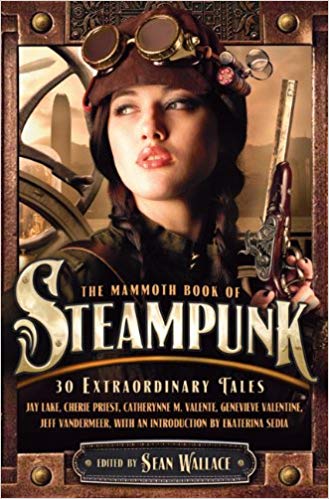
30 anarchic mash-ups of past and future that push the boundaries of steampunk.
Great steampunk stories confront an uneasy history of oppression – of women, other ‘races’ and classes – and the abuse of science, by reimagining the past. The writers represented in this outsatnding collection look to the future through the lens of the past, imagining worlds in which technology is used to uplift rather than to oppress.
I’ve only recently gotten involved in steampunk. It’s a
genre that I only started reading late last year and one that I kind of love. Although,
as I discovered with this collection of short stories, it is also a genre that
I have to concentrate a little more to read (unlike genre such as romance).
This anthology runs the gambit of steampunk stories and brings
a number of themes, styles and settings to life. It is a perfect way to
completely disappear from the world after a long day. Although, with many of
the themes, once you have finished the story you are thrown back into reality
ten times more heavily than you were before. After all, most of these stories have
a great commentary about the world that we live in today.
From capitalism to feminist movements, every major issue and
discussion that seems to be occurring in modern society is touched upon in this
collection. Yet, these aren’t all serious commentaries on the world. Some of
the stories are kind of hilarious, and some are downright weird. The one thing
that they all have in common is that they are thoroughly enjoyable and have
helped to give me a new addiction.
Olive has visited Wonderland and finds that things aren’t all as they ought to be. Meanwhile, Mrs Hargreaves and Peter are sitting down for a dinner and reminiscing on the pasts that were stolen, but never should have been.
This is a bit of a jumpy short story. Which is pretty typical for a tale from Mad Hatters and March Hares if I’m being truly honest with myself. But, it felt kind of jumpier and more confusing than some of the other stories that I had read. Not to say that it was bad… but it did take me a little more to understand what I was reading than usual. I actually read through this twice… just because there was not one, but two different storylines to try and get my damn head around.
Although I liked the storyline about Olive, it was the secondary
tale that really caught my attention. The parallels drawn between Peter Pan and Alice were ones that I had
never even considered. But they were really powerful and potent in their own
way. And now, when I finally get the time to read Peter Pan, I’m going to be drawing those connecting lines the
entire time.
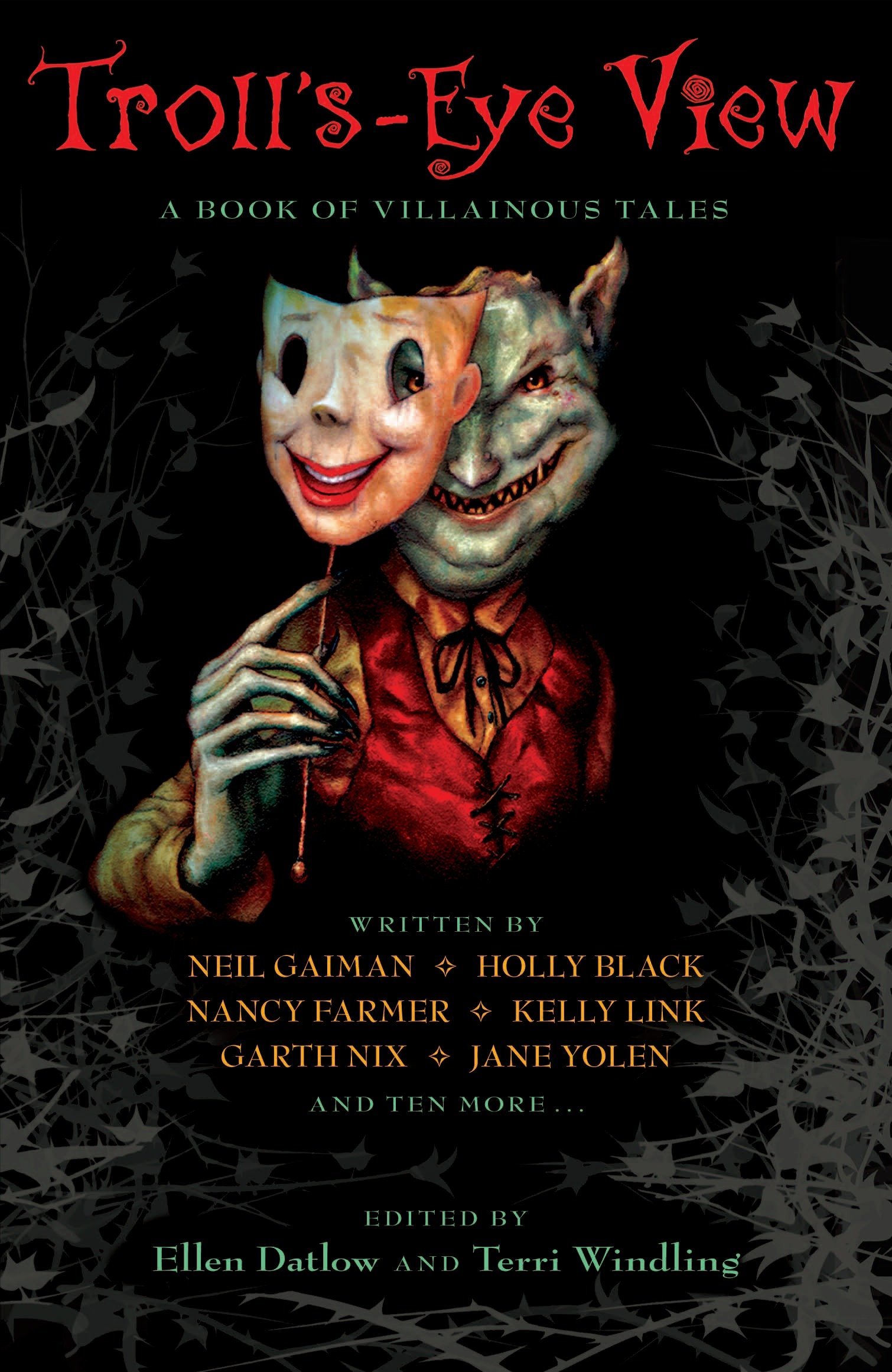
Everyone thinks they know the real story behind the villains in fairy tales – evil, no two ways about it. But the villains themselves beg to differ. In this book you’ll hear from: the Giant’s wife from “Jack and the Beanstalk” the oldest of the Twelve Dancing Princesses Rumpelstiltskin the witch from “Hansel and Gretel” someone called Evil Cinderella
Just watch these old stories do new tricks!
This is an incredibly easy, fun and engaging short story
collection. It takes some brilliant authors who take you on journeys through
well known fairy tales. The fact that these retellings all focus on the
villains of the stories just made me love it even more. I always love the
highlighting of grey areas and alternate tellings.
Troll’s-Eye View is a collection that is written for a very young age group. It’s simple and quaint. Easily accessible and fun. But, that doesn’t mean that as an adult you can’t enjoy it. There was nothing I enjoyed more than sitting down at the end of a long day and reading one of these short stories or poems. It was a great, fun and quick escape from the real world at a time when I’ve been really quite overwhelmed and stressed.
Most of my anthologies and collections contain only novellas
and short stories. Troll’s-Eye View also
has poems. They were enough to break up the flow throughout the story and leave
you with a smile on your face.
Title: A Delicate Architecture Author: Catherynne M. Valente In: Troll’s-Eye View (Ellen Datlow & Terri Windling) Rating Out of 5: 5 (I will read this again and again and again) My Bookshelves:Fairy tales, Food, Villains Dates read: 27th February 2019 Pace: Medium Format: Short story Publisher: Firebird Fantasy Year: 2009 5th sentence, 74th page: He gave me a slice of honeycomb and shooed me into the garden, where raspberries grew along the white gate.
Constanze has always wanted to go to Venice with her father, but when opportunity finally knocks, she finds that not everything is as it seems.
I’ve never really questioned why there was a gingerbread
house in Hansel and Gretel. Or why it seems to be something that is repeated
across fairy tales. After all, it is a really impractical and useless way in
which to make a house. And it kind of seems just… sticky to live in.
Valente was able to give a completely plausible reason for the building of a gingerbread house. And a completely understandable way in which the wicked witch from Hansel and Gretel turned out the way that she did… everything about this story just helped to create a reality in which the well-known fairy tale actually makes sense. After it had first poked the holes in it.
As much as I loved this story, it also made me feel kind of
sad. The father betrays and then forgets his daughter. She is left unloved, unremembered
and just completely stranded. All so he can regain the fame and fortune that he
once had.
Jane Sallow is taken into custody for the paraphenalia that she is distributing. But as the story unfolds, a strong message is given to the Baliffs who have trapped her.
The flow of this is not even remotely what I’m used to, or what I expected. Jane’s story is told, but it is also partnered with the wording in her fliers. Quick, pithy sentences that get the point across – mostly about feministic values such as equality. Or at least, that was what I got out of this story.
There is a sense of Jane being the messiah and the one to teach others to better their ways. Although, this was kind of hard to get at – because the storyline is jumpy, kind of complex and just generally a lot of fun.
Although this short story didn’t have the same intensity of steampunk as the rest in this collection so far, it did have the themes and messages that I’m becoming used to.









 Earth and Skye