All animals have to reproduce. It’s how the next generation is created and how an animal’s genetics are passed on. But how do two male cuttlefish fight for a mate? Most fish don’t have to compete, as they release clouds of sperm and eggs into the water and fertilisation occurs. Most large land mammals have epic battles that end in the crashing of two large bodies together, and some whales have marathon races that last for hours, so that the female can determine the fittest and most suitable mate.
Giant Australian cuttlefish don’t have the ease of releasing clouds of eggs and sperm into the water and nor do they have the capacity to gauge their opponents’ capabilities like a mammal or bird, or so we thought. A recent study from Macquarie University has found that male cuttlefish do, in fact, ‘size up’ possible rivals before engaging in combat and react accordingly. This ability to size up rivals means that only 20% of all male interactions actually end in physical combat.
By applying game theory, behaviouralists in Sydney were able to measure and witness the ways in which the male cuttlefish’s actions changed dramatically according to the length of its rival. Whilst this has been recorded when small, unpaired males are faced with much, much larger, paired males, it wasn’t known how far this behavioural adaptation carried through their activities. In other words, if a submissive, unpaired male was faced with another small, unpaired male that was obviously shorter than it (measured by the mantle length), then the first male would put on an aggressive display. This consists of flashing colours along their sides, the waving and stretching of tentacles and swimming towards the interloper. But, if that same male was approached by a male that was longer than it, it immediately stops the light display and removes itself from the situation.
But why should we care? It’s long been known that many species of mammal and bird when engaging in male-male conflict will employ ‘resource-holding potential’ theory. In other words, if the other male is bigger, nastier and scarier, the smaller one will admit defeat and try its luck elsewhere. If two males are of similar size and strength, then they will commit to combat and the winner is left with his choice of females while the loser, yet again must admit defeat and leave.
The fact that ‘resource-holding potential’ is evident in Australian cuttlefish tells us a number of things about these fascinating creatures. For starters, it is just another piece of behavioural evidence that shows how intelligent these colourful and intriguing creatures are. This ability to judge another and compare a rival to oneself is also a very good indication of analytical capabilities. And lastly, the ability to judge a rival and assess your chances of winning in combat shows that this behavioural capability may have evolved because of selection pressures across many different groups of animals.
So there you go, even male cuttlefish measure one another up before starting a fight.
Every animal, from the smallest insect to humans travels through life on a journey from birth to death. We all go through it, but there are six major stages that are familiar across all groups on land and under the sea. Last year’s BBC series, ‘Life Story’ takes you through this exact journey, so does their latest exhibition at Vivid in Sydney, also conveniently called ‘Life Story’. Anyone who loves David Attenborough (as I do) will know that he also focuses on these six stages of life throughout many of his tales. So here are the six stages of life, and some really fascinating animals to match:
First Steps
We all have to take our first steps in the world, for some creatures, like wildebeest and antelope, this happens within moments of birth. If prey animals like this can’t run within moments of delivery, then it’s really likely that a large carnivore will make quick work of their tiny and vulnerable bodies. It is the ability of such small vulnerable creatures to escape from predators that has caused the Hoatzin (Ophisthocomus hoazin) to be one of the most unique birds in the animal kingdom.
It has become well-known within the scientific community that the Hoatzin is a hint at the link between birds and dinosaurs. This is because it has grasping hooks on its wings when first hatched. As their wings become strong enough to carry them through the air, the claws eventually fall off and the Hoatzin looks like just any other bird.
Growing Up
Growing up takes time, a little for some, a lot more for others (as I’m sure most people would understand). But the longest and shortest nursing periods for mammals both belong to the pinnipeds (seals, sea lions and walruses). In these mammals the lactation period (the time that the young is fed milk by its mother) is often the same time as that of motherly care. Once the mother stops providing the infant with sustenance, they must fend for themselves.
For the Hooded Seal (Cystophora cristata) they must grow up within a mere four days. Over these four days the pups’ weight almost doubles from roughly 25kg to 50kg because of the high fat content of their mother’s milk (60%). And it needs to! The Hooded Seals live on the pack ice in the Arctic Ocean and they need to be able to fend for themselves once they are left to their own devices.
The animal with one of the longest lactation period on the other hand is the Walrus (Odobenus rosmarus). They nurse their young for anywhere between two and two and a half years. Some of their young have even been known to spend up to five years with their mothers before having to fend for themselves. Although, this is not by any means the longest period of ‘growing up’ in the animal kingdom; that crown belongs to humans. It takes us 18 years or more to be considered ‘grown’ and able to fend for oneself.
Home
By far, one of my favourite animal homes of all times is that of the ‘magnetic termites’ (Amitermes) of Northern Australia. When the queen leaves her home, she finds herself a mate and starts creating one of these majestic homes. They are the pinnacle of nature’s ingenuity in dealing with some of the extremes of the surrounding environment. These termites build their homes in areas that are prone to flooding and are constantly under the harsh Australian sun. This is why the termite mounds are tall to lift the insects out of the flooded plan and angled in a North to South direction. The mounds are eerily aligned in this way to reduce the surface area that is exposed to sunlight throughout the day and therefore the amount of heat that the animals have to experience.
Power
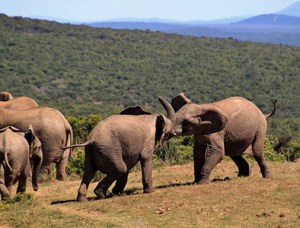
We all vie for power in one way or another in our daily lives. Those with the most power eat first, have their choice of mates and are far less likely to be eaten by predators. Elephants don’t have to worry about being eaten by other predators once they’ve ‘grown up’, but they do fight for power regardless, especially the males. This allows the biggest, toughest and most likely to survive male to mate with more females and make more big, tough and resilient offspring. Dominance fights helps to sort out this hierarchical system within both Asian (Elephas maximus) and African (Loxodonta Africana spp) Elephants. Often at the conclusion of these, the champion flicks the other bull’s penis with his trunk to assert his dominance.
However, in some herds of African Elephants, the bachelors also form their own herd which serves a secondary purpose. The patriarch (head male) not only keeps the younger males from passing on their genes to all other females, but he also teaches them how to act and stops them from becoming out of control when in musth. This use of power not only helps to pass on the “fittest” genes to the next generation, but teaches the younger bulls how to act appropriately and thus conserves the species.
Courtship
Courtship takes many forms, from vibrant displays to titanic clashes, but some of the most spectacular and beautiful of these is done by birds. The Bowerbird (Ptilonorhynchidae) decorates a nook with beautiful objects to attract a mate, each of which is placed with great love and care. The Bald Eagles (Haliaeetus leucocephalus) on the other hand lock talons in a death defying ritual as they plummet to the earth.
The most vibrant and beautiful of all of these courtship rituals though is those performed by the Birds of Paradise. These astonishingly beautiful birds have been hunted to the brink of extinction in some areas of New Guinea. Their bright and distinct feathers are not only used in the courtship rituals of these stunning creatures, but also in the courtships of some humans. They attach the feathers to their headdresses and dance for the women to choose the best looking man.
Parenthood
IF you can get through growing up. IF you can find a home. IF you become the biggest baddest beast in the land. And IF you find yourself a mate, then the final trial of life must be experienced; parenthood. Some of the most dedicated parents exist in the animal kingdom. Like all of the six stages of life, there are a lot of admirable parents in the animal kingdom.
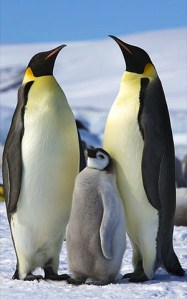
I think that the top of this list is always going to be the male Emperor Penguin (Aptenodytes forsteri). These amazing parents hold their eggs on their feet for 65 – 75 days to incubate the egg. Standing with your toes turned up for this long sounds tedious and painful in the least, but try combining this with the frigid temperatures of the Antarctic at the beginning of Winter. When these chicks finally hatch, the male continues to hold them on their feet and guard them until the female returns from her hunting trip. When the male finally relinquishes his precious cargo, he hasn’t eaten for at least four months! The parents swap these duties until the chick is able regulate its own body heat. But, once they can be left alone, their responsibilities don’t end, they constantly feed up their chick, until almost a year later; it is able to start hunting for itself.
There are so many different ways that animals make their way through the six stages of life. Just think about how you have grown up and how your friends have. The animal kingdom has so many astounding and surprising ways to pass on the genes to the next generation, you could spend your entire life studying them, and indeed, some people do.



 Earth and Skye