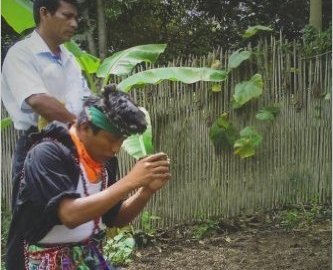

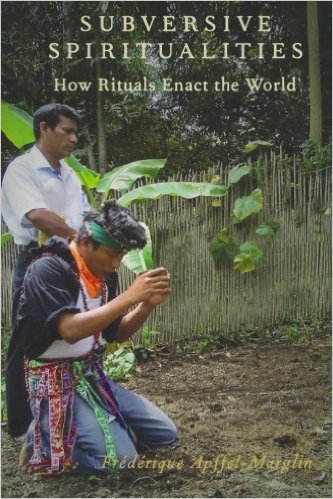
Title: Subversive Spiritualities: How Rituals Enact the World
Author: Frederique Apffel-Marglin
Rating Out of 5: 4 (Really good read!)
My Bookshelves: Anthropology, Mythology, True stories, Non-fiction
Pace: Slow
Format: Ethnographic text
Publisher: Oxford University Press Inc
Year: 2012
5th sentence, 74th page: It goes much further than simply the health of an individual.


Even in the twenty-first century, some two-thirds of the world’s peoples quietly live in non-modern, non-cosmopolitan places. In such places the multitudinous voices of the spirits, deities, and other denizens of the other-than-human world continue to be heard, continue to be loved or feared or both, continue to accompany human beings in all their activities. In Subversive Spiritualities, Frederique Apffel-Marglin draws on a lifetime of work with the indigenous peoples of Peru and India to support her argument that the beliefs, values, and practices of such traditional peoples are ”eco-metaphysically true.” In other words, they recognize that human beings are in communion with other beings in nature that have agency and are kinds of spiritual intelligences, with whom humans can be in relationship and communion.
Ritual is the medium for communicating, reciprocating, creating and working with the other-than-humans, who daily remind the humans that the world is not for humans’ exclusive use. Apffel-Marglin argues that when such relationships are appropriately robust, human lifeways are rich, rewarding and, in the contemporary jargon, environmentally sustainable. Her ultimate objective is to ”re-entangle” humans in nature, by promoting a spirituality and ecology of belonging and connection to nature, and an appreciation of animistic perception and ecologies. Along the way she offers provocative and poignant critiques of many assumptions: of the ”development” paradigm as benign (including feminist forms of development advocacy), of most anthropological and other social scientific understandings of indigenous religions, and of common views about peasant and indigenous agronomy. She concludes with a case study of the fair trade movement, illuminating both its shortcomings (how it echoes some of the assumptions in the development paradigms) and its promise as a way to rekindle community between humans as well as between humans and the other-than-human world.

This book was such a unique experience for me – it was an engaging and insightful look into phenomenological ethnography. For those of you who don’t know (as I didn’t when I started reading this book), phenomenology is the different ways in which we view the world. Our phenomenological understandings of our realities are shaped by culture, personal experience and spiritual considerations, amongst other things. Ethnographies, of which I have read a few, are anthropological texts. Ethnographies involve the author immersing themselves into another’s culture and life. Here they participate and observe at the same time, at once part of the group and separate.
I found this ethnography to be really theoretically engaging, and whilst I have read others, this is the one that left me thinking for a long time after I closed its pages. Not only did Apffel-Marglin open up a whole new realm of studies and theoretical points upon which to pursue my own research, it also introduced me to the world of agriculture in the Peruvian Andes. I loved the combination of scientific understandings and cultural knowledge in the care for these passionate people’s environment. And delving into such a wonderful blend of objective and subjective knowledges of the world struck a chord deep within me. So much so that I used this idea within my own Anthropological Honours thesis.
Not only was the subject matter of Subversive Spiritualties highly engaging, Apffel-Marglin’s writing style was incredibly engaging – you couldn’t help but be pulled into the world she so vividly describes. It was also highly appreciated that she was so aware of her own biases. It helped to highlight my own cultural biases and the ways in which our views of the world completely colour everything that we experience and see.
| <- More non-fiction reviews | More anthropology reviews -> |

 Earth and Skye