Tag Archives: Cuttlefish

Swimming with Cuttlefish

Originally published by ReefWatch SA on 5 July 2016.


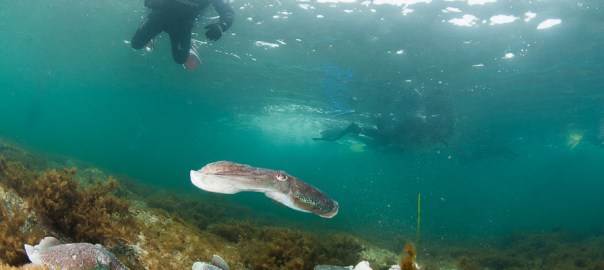
There are some moments that I’m sure I’ll always remember and treasure in my life – and snorkeling with the mating cuttlefish at Stony Point (near Whyalla, South Australia) has definitely made it onto that list. As a slightly obsessed nature buff, I have seen numerous documentaries that talk about this awesome phenomenon. Seeing it in person, was far more extraordinary than even these shows had led me to believe.

Watching the changing colours along the males’ sides is even more stunning in real life, and the sheer size of some of the cuttlefish completely took my breath away. Who knew that such docile creatures could grow to be so big? I certainly didn’t. And then there were my favourite males, the sneaky ones. I tried really hard not to giggle (since that would mean swallowing a lot of seawater) as I watched them sneak in underneath the dominant males to mate with the females. Smiling, I got to witness an act of nature that left me awestruck and grinning from ear to ear.

I don’t think I’ve ever spent such a peaceful half an hour just enjoying the world around me. Something about the ocean makes you feel lovingly isolated and completely at one with the world around you, even when you are surrounded by a dozen other snorkelers. Floating face down in the water and just absorbing what was unfolding below reminded me of the beauty of our blue planet. A memory that will help me get through hours of tedium while studying and working.

Nature provided an amazing spectacle, but it was Experiencing Marine Sanctuaries that made the day so pleasurable. From the moment of registration, we felt welcomed and part of the group. I’m sure that I asked some silly questions, but the team was more than willing to help someone who hasn’t snorkeled for almost ten years. They were also willing to take into account everyone’s swimming and snorkeling experience – from the girl who wasn’t a confident swimmer to those who seem to spend every spare moment in the water, everyone was catered for.

After spending the afternoon at Stony Point and enjoying the wonders that were on offer, I can’t wait for the next EMS snorkeling trip. If you haven’t made the time to go and watch the phenomena of the mating cuttlefish, I would definitely recommend taking the time. It’s an experience that you don’t want to miss, and you’ll never regret!

To ensure you are on the invitation list for next years event subscribe to the EMS newsletter at www.emsau.org or click here

Images taken by Carl Charter

Cuttlefish Choose Their Battles Wisely

Originally published by ReefWatch SA on 5 August 2015.

Photo by Carl Charter

All animals have to reproduce. It’s how the next generation is created and how an animal’s genetics are passed on. But how do two male cuttlefish fight for a mate? Most fish don’t have to compete, as they release clouds of sperm and eggs into the water and fertilisation occurs. Most large land mammals have epic battles that end in the crashing of two large bodies together, and some whales have marathon races that last for hours, so that the female can determine the fittest and most suitable mate.

Giant Australian cuttlefish don’t have the ease of releasing clouds of eggs and sperm into the water and nor do they have the capacity to gauge their opponents’ capabilities like a mammal or bird, or so we thought. A recent study from Macquarie University has found that male cuttlefish do, in fact, ‘size up’ possible rivals before engaging in combat and react accordingly. This ability to size up rivals means that only 20% of all male interactions actually end in physical combat.

By applying game theory, behaviouralists in Sydney were able to measure and witness the ways in which the male cuttlefish’s actions changed dramatically according to the length of its rival. Whilst this has been recorded when small, unpaired males are faced with much, much larger, paired males, it wasn’t known how far this behavioural adaptation carried through their activities. In other words, if a submissive, unpaired male was faced with another small, unpaired male that was obviously shorter than it (measured by the mantle length), then the first male would put on an aggressive display. This consists of flashing colours along their sides, the waving and stretching of tentacles and swimming towards the interloper. But, if that same male was approached by a male that was longer than it, it immediately stops the light display and removes itself from the situation.

But why should we care? It’s long been known that many species of mammal and bird when engaging in male-male conflict will employ ‘resource-holding potential’ theory. In other words, if the other male is bigger, nastier and scarier, the smaller one will admit defeat and try its luck elsewhere. If two males are of similar size and strength, then they will commit to combat and the winner is left with his choice of females while the loser, yet again must admit defeat and leave.

The fact that ‘resource-holding potential’ is evident in Australian cuttlefish tells us a number of things about these fascinating creatures. For starters, it is just another piece of behavioural evidence that shows how intelligent these colourful and intriguing creatures are. This ability to judge another and compare a rival to oneself is also a very good indication of analytical capabilities. And lastly, the ability to judge a rival and assess your chances of winning in combat shows that this behavioural capability may have evolved because of selection pressures across many different groups of animals.

So there you go, even male cuttlefish measure one another up before starting a fight.

Academic Paper Link: http://www.sciencedirect.com/science/article/pii/S0003347215002237