Originally published by ReefWatch SA on 31 March 2016.
 Image: https://en.wikipedia.org/wiki/Alpheidae
Original research article: http://rspb.royalsocietypublishing.org/content/283/1826/20153046
If you love marine life (which you obviously do since you’re getting the Reef Watcher), then you’ve heard about ocean acidification. Actually, I think that just about everybody has heard about it. And every time we turn around, scientists have discovered a new problem associated with it. Or at least that’s how it seems because it turns out that ocean acidification is now silencing our oceans. Who knew?
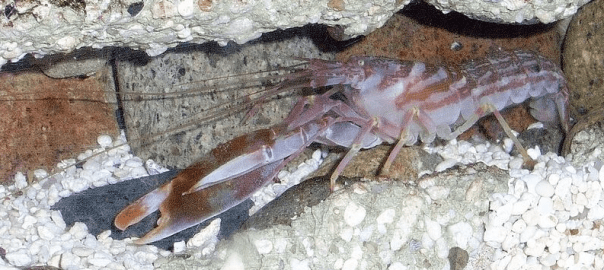
To make more sense of this phenomenon, you probably need to know what sounds we’re talking about. And weirdly enough, you’ve probably all heard them – you just haven’t realised what you are listening to. It’s shrimp. Snapping shrimp to be exact. This video explains it really well: https://www.youtube.com/watch?v=PCW789vj7t4&feature=youtu.be
Basically, it’s the crackling sound that people sometimes hear near and within the ocean – that’s snapping shrimp. They are one of the loudest invertebrates in the ocean and create the ‘snapping’ or crackling sound by closing their claws very fast. This creates an air bubble that can release a sound of up to 210 dB! That’s the equivalent of an earthquake with a Richter scale of 2.0 and is louder than a rocket launch! And at 194 dB, sound waves become shock waves! They normally use this phenomenal talent to catch prey or scare off predators. But this sound is important in another way – baby fish also use this sound to navigate the sea.
Not only will snapping shrimp be in more danger if they don’t ‘snap’ frequently, but it could also have larger effects on the ecosystem. If baby fish can’t navigate through the oceans, then they are far more likely to become someone else’s lunch. Sound is the most reliable way to navigate in the water since light and smells can become distorted in the currents. Sound also travels thousands of kilometres, unlike water, which travels a few metres.
How is a rising CO2 level in the water changing the sound I hear you ask? Well, three researchers from Adelaide University, Mr. Tullio Rossi, Associate Professor Ivan Nagelkerken and Professor Sean Connell, studied the snapping shrimp surrounding volcanic vents in three locations off the coast of New Zealand. These vents are natural sources of CO2 and give us a fairly important insight into the effects that ocean acidification could have. The CO2 levels around these areas are equivalent to what scientists have predicted will be observed in 2100.
It was found that snapping shrimp made a smaller and less frequent noise when they were in locations with more CO2. No physical differences were found in these shrimps, meaning that something about this level of carbon dioxide within the water affects their behaviour. In other words, more carbon dioxide means less noise. If the world keeps warming as it has, this will turn our happy, clappy reefs into silent, directionless areas.
Not an outcome anybody wants.
 Earth and Skye